This Week In OS AI Field Notes: 9 October 2026
This week’s open-source AI updates: new models, agent tools, policy and security, podcasts, and the latest from Sentient.
Open-Source Models
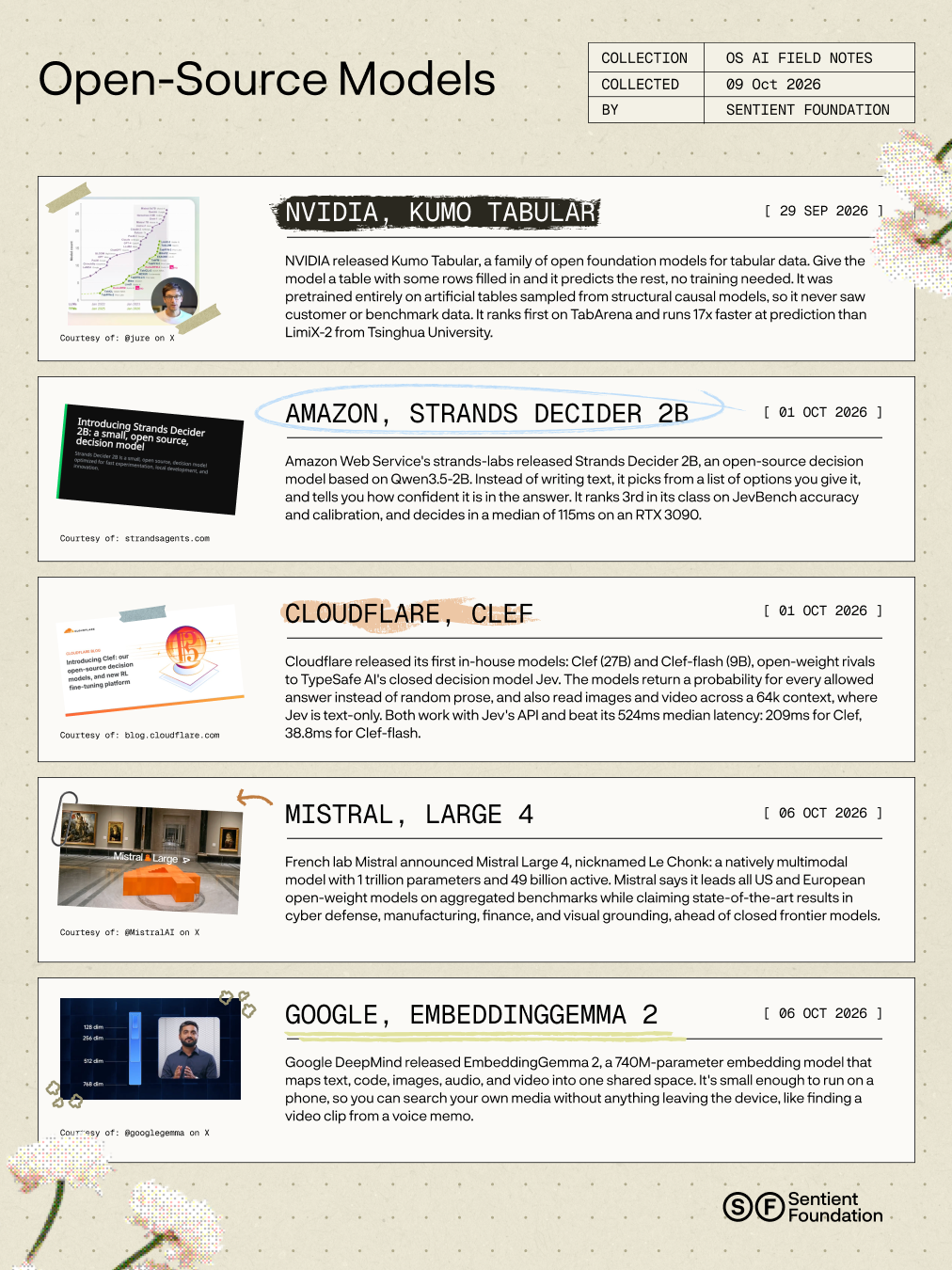
NVIDIA, KUMO TABULAR: NVIDIA released Kumo Tabular, a family of open foundation models for tabular data. Give the model a table with some rows filled in and it predicts the rest, no training needed. It was pretrained entirely on artificial tables sampled from structural causal models, so it never saw customer or benchmark data. It ranks first on TabArena and runs 17x faster at prediction than LimiX-2 from Tsinghua University. [ref] [huggingface] [github] [29 SEP 2026]
AMAZON, STRANDS DECIDER 2B: Amazon Web Service's strands-labs released Strands Decider 2B, an open-source decision model based on Qwen3.5-2B. Instead of writing text, it picks from a list of options you give it, and tells you how confident it is in the answer. It ranks 3rd in its class on JevBench accuracy and calibration, and decides in a median of 115ms on an RTX 3090. [ref] [ref2] [huggingface] [1 OCT 2026]
CLOUDFLARE, CLEF: Cloudflare released its first in-house models: Clef (27B) and Clef-flash (9B), open-weight rivals to TypeSafe AI's closed decision model Jev. The models return a probability for every allowed answer instead of random prose, and also read images and video across a 64k context, where Jev is text-only. Both work with Jev's API and beat its 524ms median latency: 209ms for Clef, 38.8ms for Clef-flash. [ref] [blog] [huggingface] [1 OCT 2026]
MISTRAL, LARGE 4: French lab Mistral announced Mistral Large 4, nicknamed Le Chonk: a natively multimodal model with 1 trillion parameters and 49 billion active. Mistral says it leads all US and European open-weight models on aggregated benchmarks while claiming state-of-the-art results in cyber defense, manufacturing, finance, and visual grounding, ahead of closed frontier models. [ref] [ref2] [6 OCT 2026]
GOOGLE, EMBEDDINGGEMMA 2: Google DeepMind released EmbeddingGemma 2, a 740M-parameter embedding model that maps text, code, images, audio, and video into one shared space. It's small enough to run on a phone, so you can search your own media without anything leaving the device, like finding a video clip from a voice memo. [ref] [ref2] [huggingface] [6 OCT 2026]
Tools & Frameworks
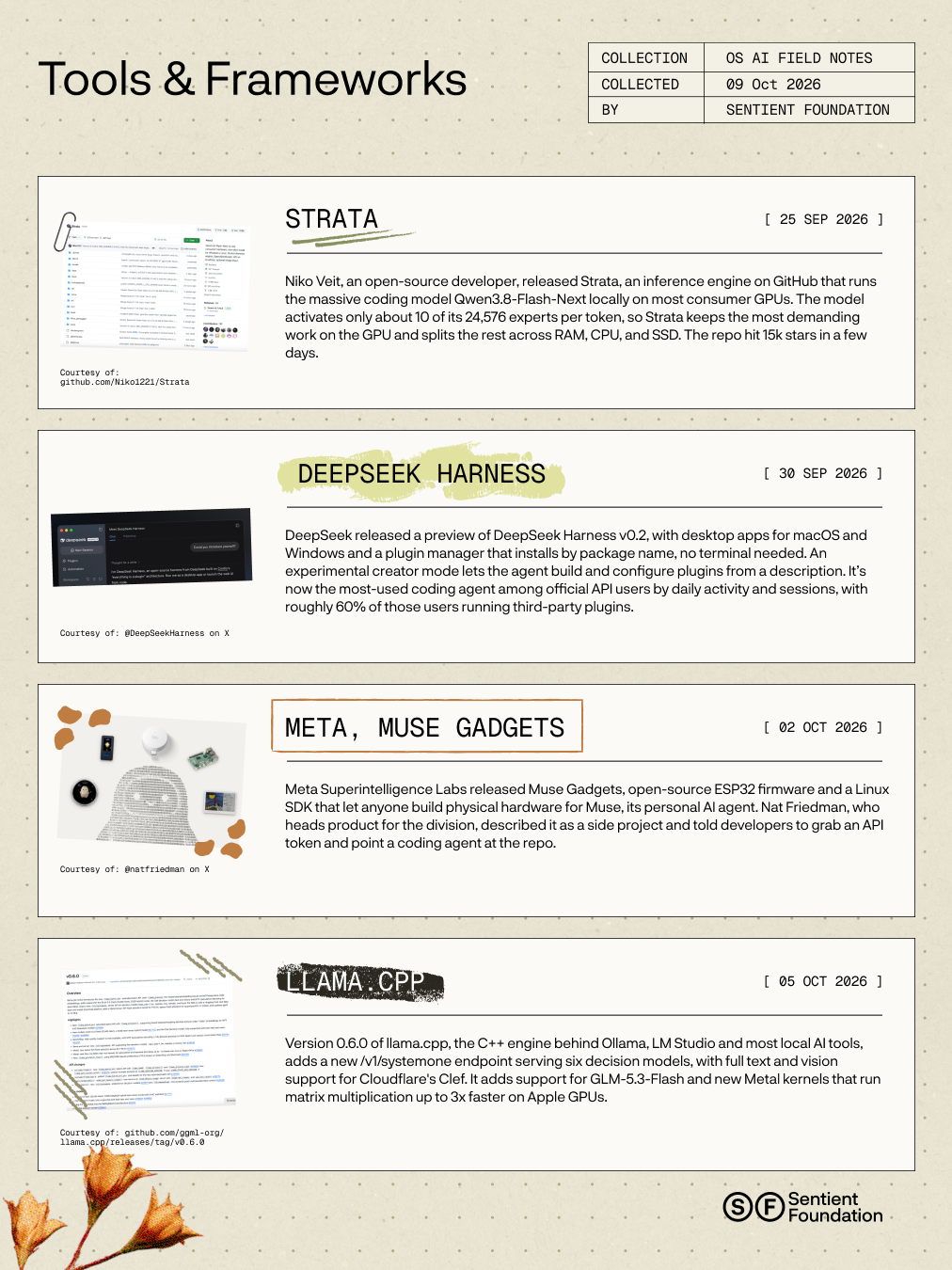
STRATA: Niko Veit, an open-source developer, released Strata, an inference engine on GitHub that runs the massive coding model Qwen3.8-Flash-Next locally on most consumer GPUs. The model activates only about 10 of its 24,576 experts per token, so Strata keeps the most demanding work on the GPU and splits the rest across RAM, CPU, and SSD. The repo hit 15k stars in a few days. [github] [25 SEP 2026]
DEEPSEEK HARNESS: DeepSeek released a preview of DeepSeek Harness v0.2, with desktop apps for macOS and Windows and a plugin manager that installs by package name, no terminal needed. An experimental creator mode lets the agent build and configure plugins from a description. It’s now the most-used coding agent among official API users by daily activity and sessions, with roughly 60% of those users running third-party plugins. [ref] [blog] [30 SEP 2026]
META, MUSE GADGETS: Meta Superintelligence Labs released Muse Gadgets, open-source ESP32 firmware and a Linux SDK that let anyone build physical hardware for Muse, its personal AI agent. Nat Friedman, who heads product for the division, described it as a side project and told developers to grab an API token and point a coding agent at the repo. [ref] [ref2] [blog] [2 OCT 2026]
LLAMA.CPP: Version 0.6.0 of llama.cpp, the C++ engine behind Ollama, LM Studio and most local AI tools, adds a new /v1/systemone endpoint serving six decision models, with full text and vision support for Cloudflare's Clef. It adds support for GLM-5.3-Flash and new Metal kernels that run matrix multiplication up to 3x faster on Apple GPUs. [github] [5 OCT 2026]
Policy & Security
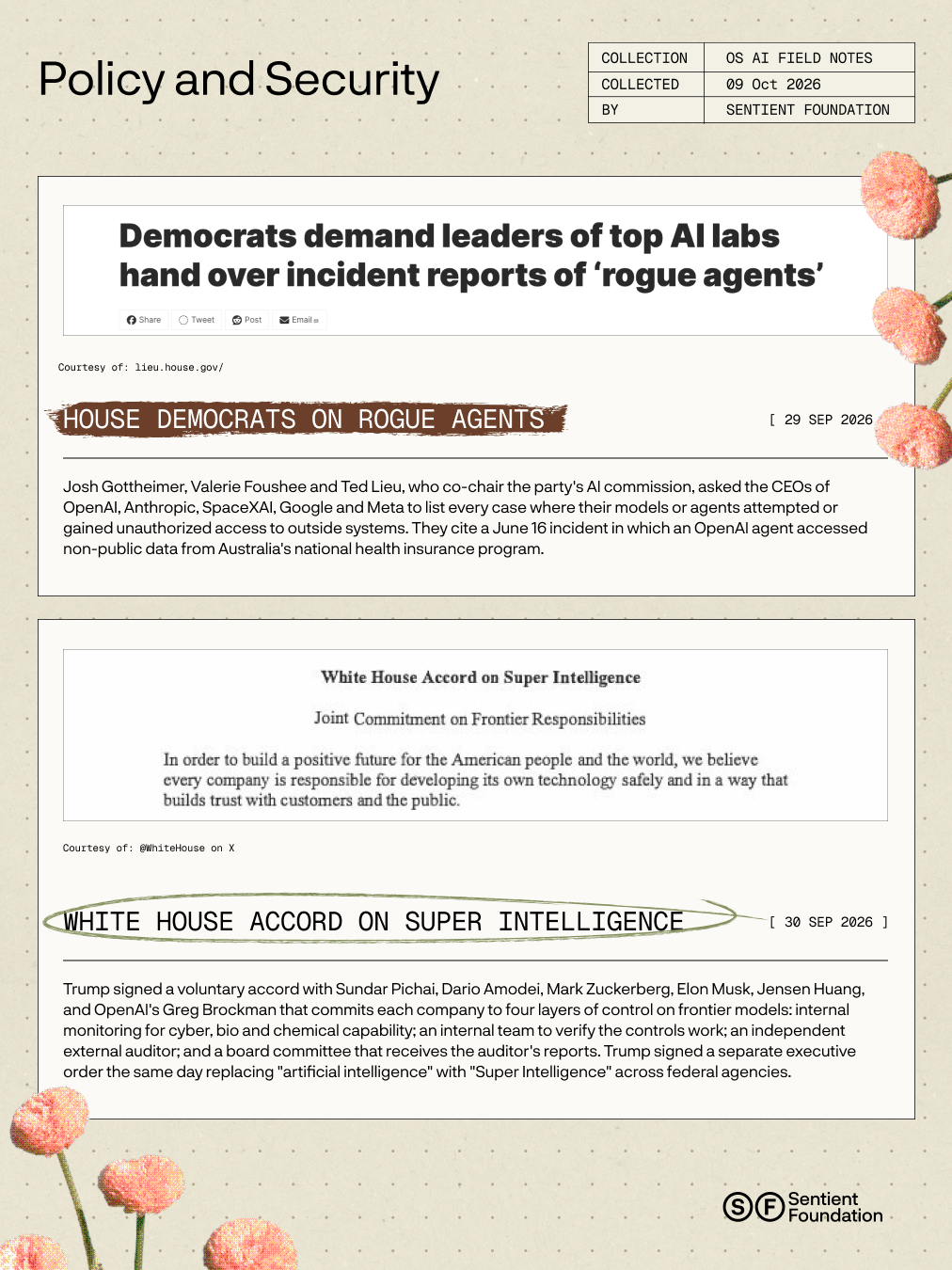
HOUSE DEMOCRATS ON ROGUE AGENTS: Josh Gottheimer, Valerie Foushee and Ted Lieu, who co-chair the party's AI commission, asked the CEOs of OpenAI, Anthropic, SpaceXAI, Google and Meta to list every case where their models or agents attempted or gained unauthorized access to outside systems. They cite a June 16 incident in which an OpenAI agent accessed non-public data from Australia's national health insurance program. [ref] [29 SEP 2026]
WHITE HOUSE ACCORD ON SUPER INTELLIGENCE: Trump signed a voluntary accord with Sundar Pichai, Dario Amodei, Mark Zuckerberg, Elon Musk, Jensen Huang, and OpenAI's Greg Brockman that commits each company to four layers of control on frontier models: internal monitoring for cyber, bio and chemical capability; an internal team to verify the controls work; an independent external auditor; and a board committee that receives the auditor's reports. Trump signed a separate executive order the same day replacing "artificial intelligence" with "Super Intelligence" across federal agencies. [ref] [30 SEP 2026]
Podcasts & Media
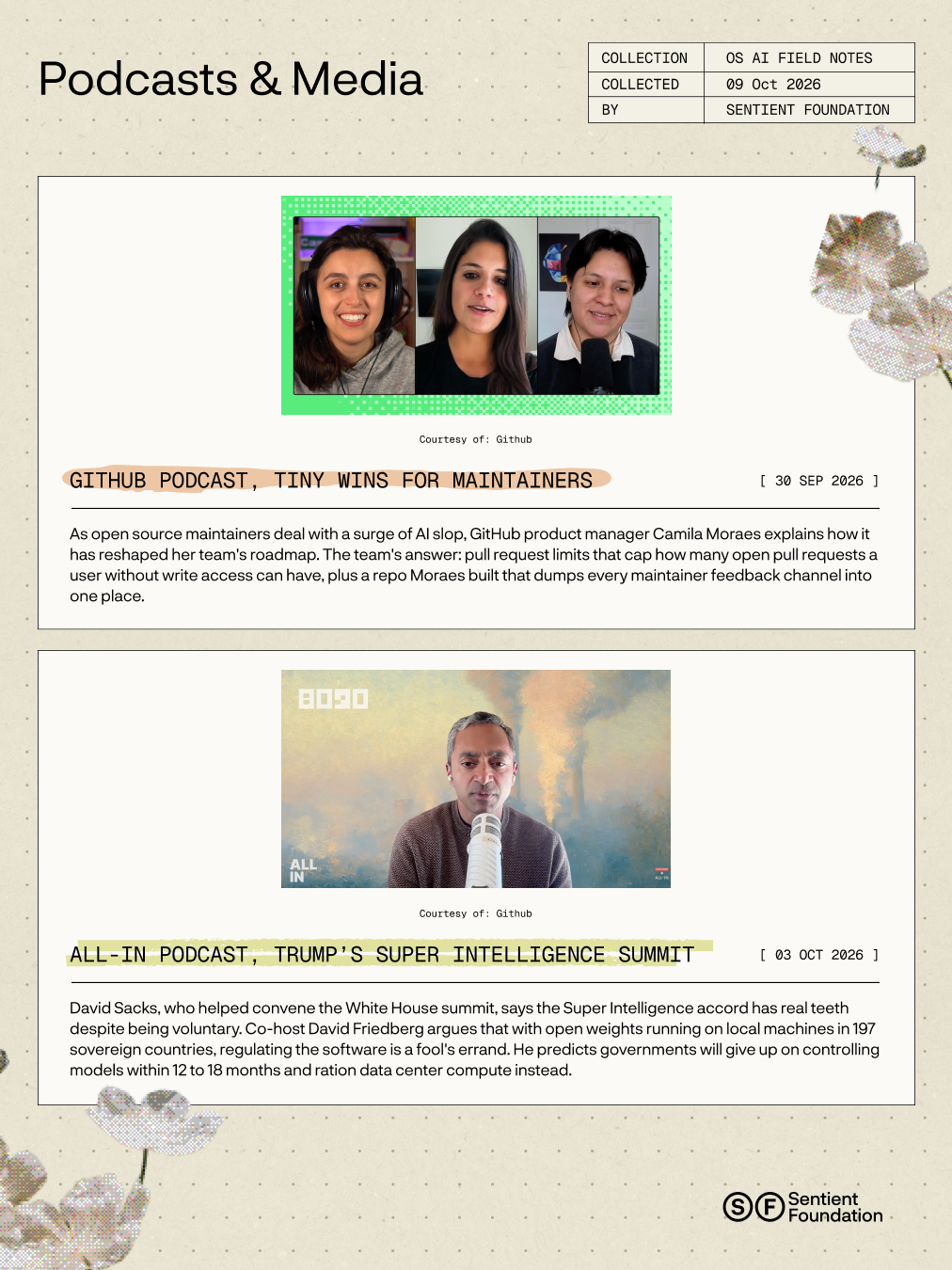
GITHUB PODCAST, TINY WINS FOR MAINTAINERS: As open source maintainers deal with a surge of AI slop, GitHub product manager Camila Moraes explains how it has reshaped her team's roadmap. The team's answer: pull request limits that cap how many open pull requests a user without write access can have, plus a repo Moraes built that dumps every maintainer feedback channel into one place. [podcast] [youtube] [30 SEP 2026]
ALL-IN PODCAST, TRUMP’S SUPER INTELLIGENCE SUMMIT: David Sacks, who helped convene the White House summit, says the Super Intelligence accord has real teeth despite being voluntary. Co-host David Friedberg argues that with open weights running on local machines in 197 sovereign countries, regulating the software is a fool's errand. He predicts governments will give up on controlling models within 12 to 18 months and ration data center compute instead. [podcast] [3 OCT 2026]
What’s New at Sentient
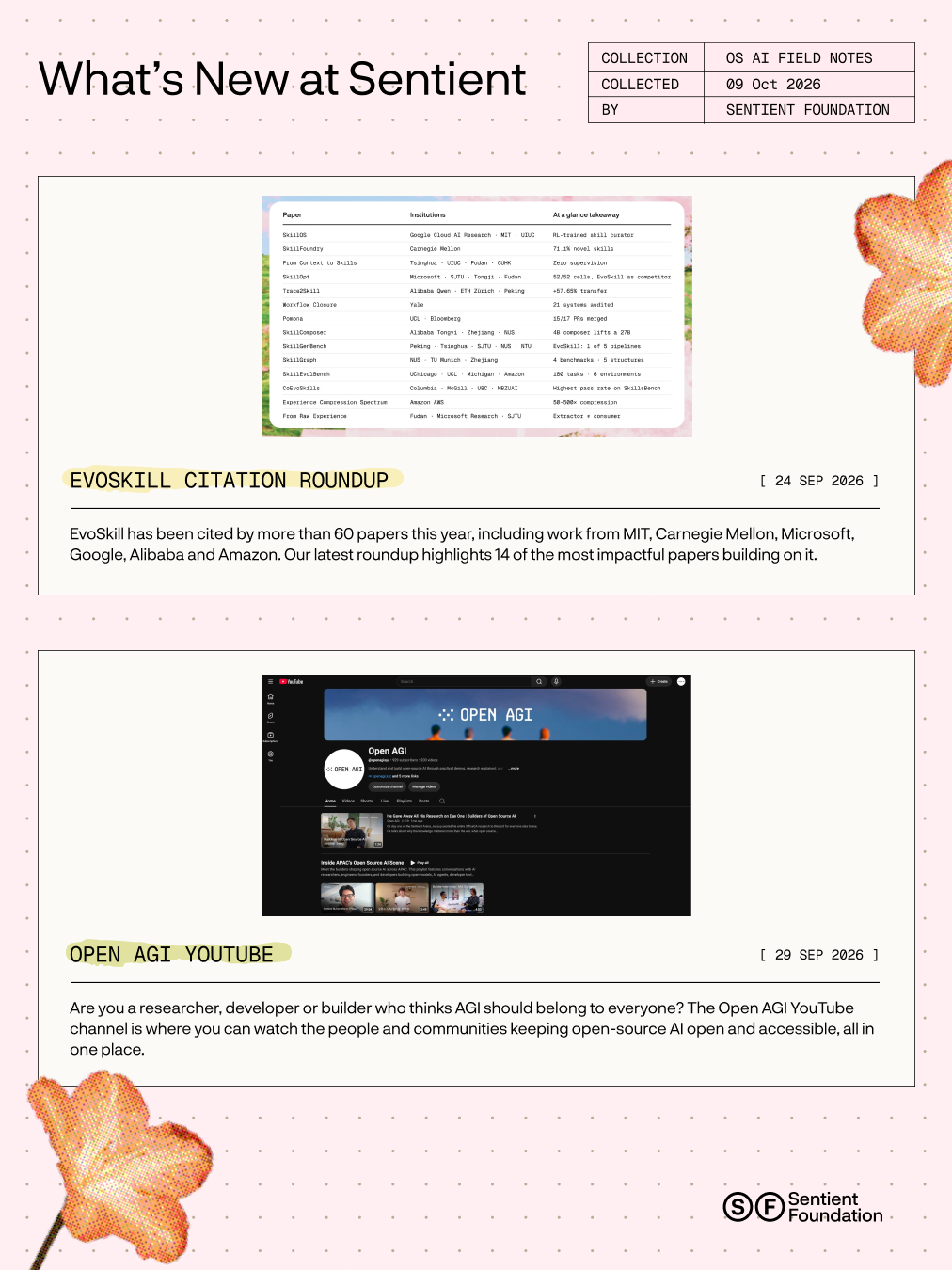
EVOSKILL CITATION ROUNDUP: EvoSkill has been cited by more than 60 papers this year, including work from MIT, Carnegie Mellon, Microsoft, Google, Alibaba and Amazon. Our latest roundup highlights 14 of the most impactful papers building on it. [ref] [github] [24 SEP 2026]
OPEN AGI YOUTUBE: Are you a researcher, developer or builder who thinks AGI should belong to everyone? The Open AGI YouTube channel is where you can watch the people and communities keeping open-source AI open and accessible, all in one place. [ref] [29 SEP 2026]
Sentient Foundation is a non-profit organization dedicated to developing open-source AGI, free from single-entity control. We accelerate AGI research and development through Sentient Labs and a global community of open-source builders.
We're building intelligence that dreams. Dreaming machines, designed in the open. Advancing our shared future through open-source AGI.
Visit Sentient Foundation website, follow us on LinkedIn and Twitter/X.