Why Tracing
Model IP Matters
The cost of training the most advanced models grew about 2.4 times a year between 2016 and 2024. If that trend continues, the most expensive publicly announced model would cost about $1 billion to train by early 2027.
Once such a model is released to the public, anyone can download its weights, adapt and redistribute them for a fraction of that cost. Fine-tuning and merging build directly on those weights, while distillation trains a new model on another model’s answers. All three can obscure where a model came from. Fewer than 30% of models published on Hugging Face explicitly name the model they were built from.
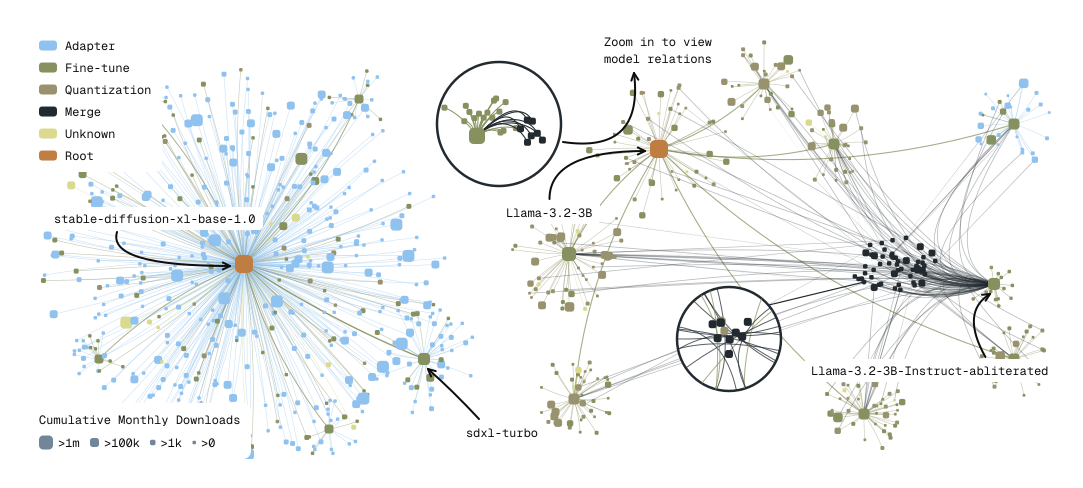
Not having transparency into a model’s behavior and origins poses legal, financial, and security risks for model creators just as much as it does for the end users and businesses.
Responsible Handling
of Model Provenance
Model provenance is the history of where an AI model came from and how it has changed over time. Our report focuses on model ancestry: which earlier models a given model was built from, whether it was fine-tuned from an existing model, merged from several, or trained to imitate another.
Model fingerprinting is one way to verify a model’s history. For example, a developer can train a model to give particular answers to a set of secret questions – answers that other unrelated models are statistically unlikely to give. If a suspect model gives those answers more often than chance would explain, that is evidence it may derive from the original. Handled responsibly, a fingerprint match is treated as evidence. On its own, however, it does not reveal a model’s full development history or establish who legally owns it.
Key Terms
Model weights: The learned numerical values inside a model that shape how it responds.
Fine-tuning: Additional training that adapts an existing model to a specific task, language, or domain.
Model merging: Combining the weights of two or more models into a new one, so its ancestry can include several sources.
Distillation: Training a new model on another model’s outputs, so it can inherit aspects of that model’s behavior without inheriting its weights.
Model fingerprint: A distinctive trait or trained-in behavior that helps identify a model or trace its origins.
What We Found
Most fingerprinting evaluations ask whether a fingerprint survives ordinary changes such as fine-tuning or merging. That is an important test of persistence, but not a test of security. A harder question is: does a fingerprint still hold up when the model’s operator is actively trying to hide it?
Together with Sentient Labs’ research collaborators, we tested ten recently published fingerprinting methods against attacks designed specifically to evade verification. Against nine of them, the attacks achieved near-complete evasion while the models kept more than 90% of their performance on standard tests. Under the models, attacks, and settings we tested, none of the ten resisted the complete attack suite.
Table 1: Vulnerabilities and attack success rates (ASR) for various model fingerprinting methods. We identify four common vulnerabilities in existing fingerprinting schemes, and propose attacks to exploit these. Our adaptive attacks achieve almost perfect ASR against verification on most existing fingerprint methods with minimal loss in utility.
Evading a fingerprint does not always require removing it. An operator who recognizes the verification questions can filter or alter the expected answers, so the fingerprint stays inside the model but never shows up when someone tests for it. This does not mean fingerprinting is futile.
What This Means
for the AI Industry
Surviving ordinary changes and resisting deliberate evasion are different capabilities, and both need to be tested before a method is called robust. Key takeaways:
- Fingerprints are evidence and should not be considered a standalone proof of ownership. A match can support a claim about a model’s origins, but it should be weighed alongside documentation, licenses, and other development records.
- Survival is not a security guarantee. A fingerprint that survives fine-tuning may still fail against someone deliberately trying to evade detection.
- Verification needs transparent testing. Shared, open evaluations should state what auditors could access, which attacks were tested, and where each method succeeded or failed.
For model creators, this means keeping clear development records and testing fingerprints against deliberate evasion. For businesses and end users, it means asking suppliers for evidence behind their claims about a model’s origins.